
Reviews and trust · Operations guide · 8 minute read
How to build an online review monitoring workflow
Monitoring is not refreshing Google every morning. It is a defined process for seeing new feedback, assigning the right response, protecting privacy, and learning from repeated themes.
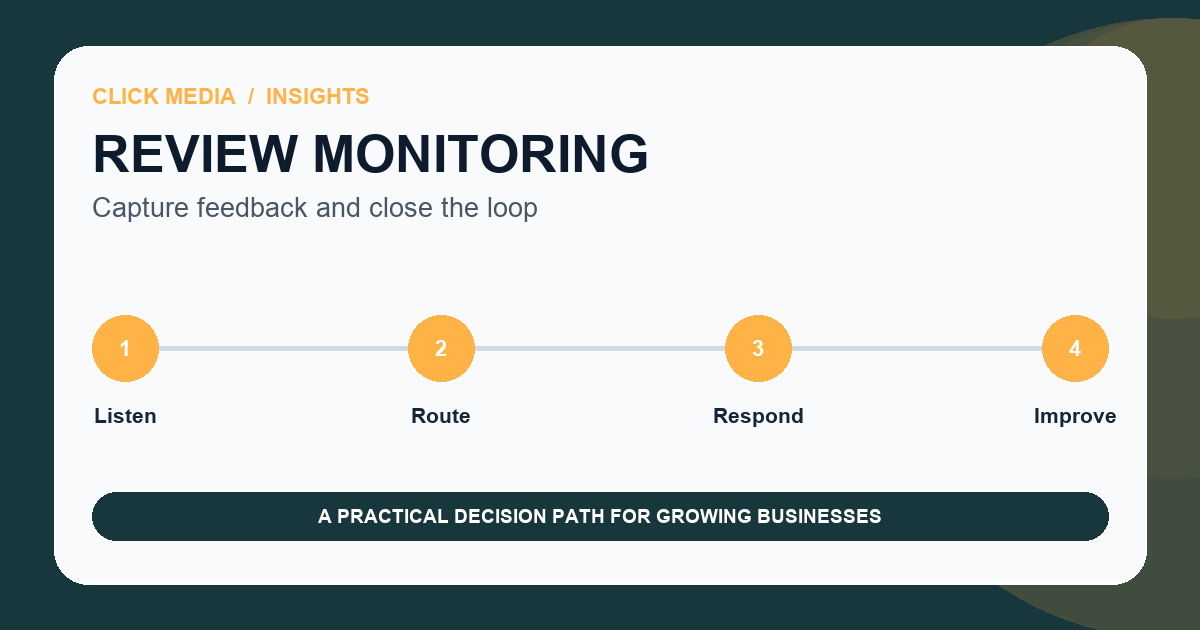
Unowned review monitoring produces two common failures: nobody responds, or several people respond without context. Both make the business look less coordinated than it is.
A simple workflow should tell the team where feedback appears, who sees it, what requires immediate escalation, who approves replies, and how the issue enters the normal customer-service process.
Inventory
Monitor the places customers actually use.
List the Business Profile, major industry platforms, social pages, marketplace profiles, and location-specific pages that influence decisions. Record ownership and alert settings.
Do not add a platform to the workflow simply because it exists. Prioritize visibility and business relevance.
Triage
Classify feedback before writing a reply.
Routine positive feedback can receive a concise, personal acknowledgment. Questions and misunderstandings need a useful answer. Service failures need an owner and private resolution path. Safety, legal, medical, discrimination, threats, or privacy issues require immediate escalation.
Set a response target that the team can meet consistently rather than promising instant replies at all hours.
Response and resolution
Public communication and private case work have different jobs.
The public reply shows attentiveness and provides an appropriate next step. Detailed investigation, refunds, records, and personal information belong in a secure channel.
Record the case outcome internally without copying private facts back into the public reply.
Learning
Review patterns, not only individual ratings.
Group feedback by themes such as communication, scheduling, quality, billing clarity, wait time, product expectations, and staff recognition.
Monthly review can reveal the operational improvements most likely to increase customer trust and reduce future complaints.
A practical next step
Review & Reputation Growth
Centralize review monitoring and response workflow when multiple profiles or recurring customer volume make manual checks unreliable.
- A steadier review rhythm
- Faster, more consistent responses
- Useful customer insight
Common questions
Practical answers before you commit.
How quickly should a business respond to reviews?+
Choose a practical service level based on staffing and risk. Sensitive complaints deserve prompt internal escalation, while routine replies should be timely without sacrificing accuracy or tone.
Should one person write every response?+
One accountable owner improves consistency, but a backup and subject-matter escalation path prevent delays and inaccurate replies.
Can monitoring include non-Google platforms?+
Yes. Include industry, social, marketplace, or location platforms that customers genuinely use, while avoiding a bloated process for low-value profiles.