
Reviews and trust · Operating guide · 10 minute read
How to build a legitimate Google review-request process
A healthy review program is not a campaign to manufacture five-star ratings. It is a repeatable way to invite genuine customers to share honest experiences, respond professionally, and learn from recurring feedback.
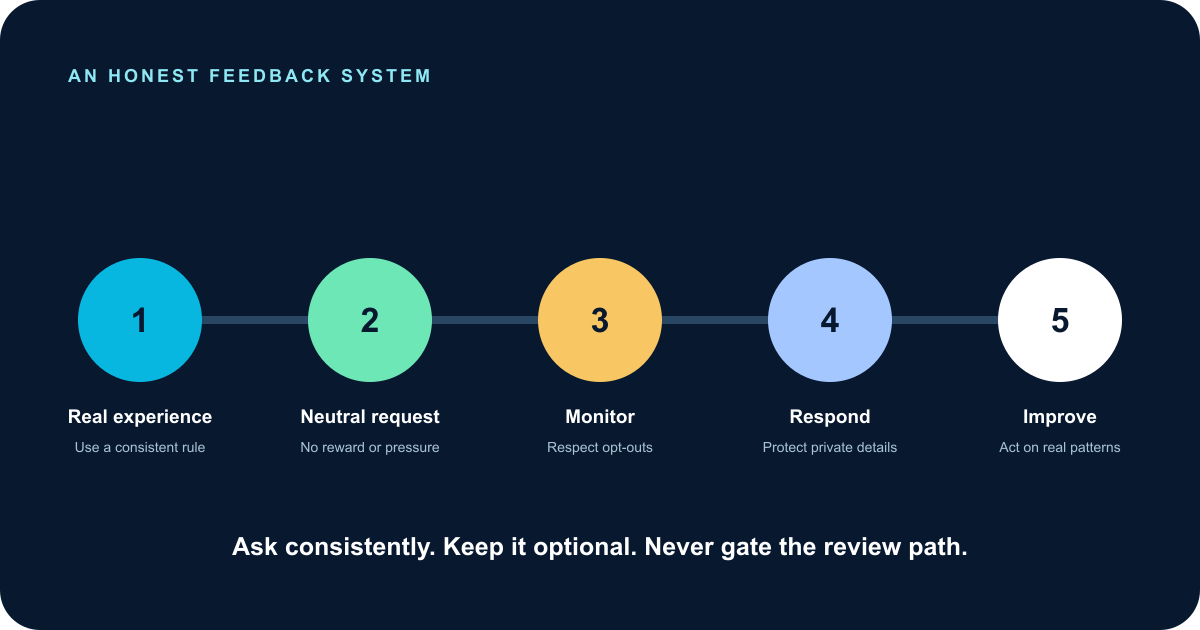
Google permits businesses to encourage reviews that represent genuine experiences. It prohibits incentives, selective solicitation of positive reviews, pressure for a specific rating or message, review swaps, and attempts to suppress or revise negative feedback in exchange for a benefit.
The safest process is also the most credible. Invite feedback consistently, make participation optional, protect customer information, and treat the review as the customer's account of an experience rather than marketing copy the business controls.
01 · Define eligibility
Ask people who had a genuine experience, using a rule the team can repeat.
Define the operational moment that makes a request appropriate: a completed appointment, delivered project, resolved support case, fulfilled order, or another genuine interaction. Use the same eligibility rule regardless of whether the employee expects praise or criticism.
Do not ask employees, relatives, contractors, competitors, or anyone with a conflict of interest to review the business. Do not create reviews on behalf of customers.
02 · Choose the moment
Make the request close enough to the experience to be useful, not intrusive.
The best timing usually follows a clear completion or value moment. A service business might ask after the customer confirms the work is complete. A professional firm might ask after a milestone or resolved matter when confidentiality permits. A retailer might ask after delivery and enough time to use the product.
Avoid repeated requests in a short period. Suppress duplicates, respect opt-outs, and make sure the team knows when a customer should not receive automated follow-up.
03 · Keep the invitation neutral
Ask for an honest review, not a five-star result.
Use simple language that identifies the interaction, explains why feedback is useful, and provides the direct review link. Do not tell customers what rating to choose, give them review text to paste, or route unhappy customers away from the public review option.
A private feedback channel can exist for support, but it cannot be used as a filter that only sends satisfied customers to Google. Everyone who meets the request rule should receive the same opportunity.
- State that the review is optional
- Ask for an honest account of the customer's own experience
- Use the same request path for every eligible customer
- Provide a direct link or QR code without scripting the response
04 · Avoid prohibited shortcuts
Incentives and selective requests can damage trust and the profile itself.
Do not offer discounts, gifts, entries, loyalty points, refunds, or other benefits in exchange for posting, changing, or removing a review. Do not ask only customers who selected a positive satisfaction score. Do not trade reviews with another business or coordinate a burst of reviews from people who did not have genuine experiences.
Google may remove policy-violating reviews and can restrict a Business Profile when it identifies fake engagement. The short-term appearance of a higher rating is not worth the credibility and account risk.
05 · Build the response workflow
A review request is only half of a reputation system.
Assign ownership for monitoring, routine replies, sensitive complaints, privacy concerns, and escalation. Positive responses can be concise and specific. Negative responses should acknowledge the concern without arguing, exposing private information, or admitting facts that have not been verified.
Move account-specific resolution to an appropriate private channel, then document the underlying issue internally. A recurring complaint about scheduling, communication, or billing is operational information, not merely a public-relations problem.
06 · Measure the process
Track consistency and learning, not only the star average.
Measure eligible customers, invitations sent, delivery failures, response rate, review volume, response time, recurring themes, and the operational changes made from feedback. A healthy program can include positive and negative reviews because real customer experiences are not identical.
The goal is a trustworthy and useful representation of the business. A perfect rating is not the operating objective.
Manual or software-assisted
Automation should improve consistency without removing judgment.
A manual process can work for a low-volume business with one accountable owner. Software becomes useful when customer volume, locations, staff, response timing, and duplicate prevention make the manual process unreliable.
The system should support neutral requests, permissions, suppression rules, monitoring, draft assistance, and human escalation. It should not create reviews, invent customer language, or decide that only happy customers deserve a public link.
A practical next step
Review & Reputation Growth
Best for a business with recurring customer volume that wants a consistent request, monitoring, and response workflow with human oversight.
- A steadier review rhythm
- Faster, more consistent responses
- Useful customer insight
Common questions
Practical answers before you commit.
Can I offer a discount for a Google review?+
No. Google prohibits incentives such as discounts, payments, free goods, or services in exchange for posting, changing, or removing a review.
Can I ask only satisfied customers for reviews?+
No. Selectively asking for positive reviews while diverting dissatisfied customers is review gating. Use the same neutral eligibility rule and request path for all genuine customers.
Can I give customers a review template?+
Do not prescribe a rating or specific review content. You can make the link easy to access and ask for an honest account of their own experience.
Should I respond to every review?+
Respond where the reply adds value. Keep responses professional, relevant, and concise. Prioritize questions, concerns, misunderstandings, and reviews where a thoughtful acknowledgment helps future customers.
What should I do with a negative review?+
Assess whether it describes a genuine customer experience, respond without exposing private information, move detailed resolution to a private channel, and report the review only if it violates platform policy.