
Local SEO · Pricing guide · 11 minute read
Local SEO pricing: what should a small business actually receive?
The useful question is not simply what local SEO costs. It is what work is included, who performs it, how decisions are made, and whether the program is connected to qualified leads.
Two proposals with the same monthly price can contain completely different work. One may provide a dashboard and suggestions. Another may include technical corrections, content, local profile work, authority building, reporting, and accountable execution. A third may be mostly citation submissions with little attention to the website or lead path.
A useful comparison starts with the delivery model, the business's starting point, and the decisions the provider is responsible for making. Price becomes easier to evaluate once the work, cadence, access, limitations, and success measures are visible.
Three common models
Match the level of help to the work your team can actually perform.
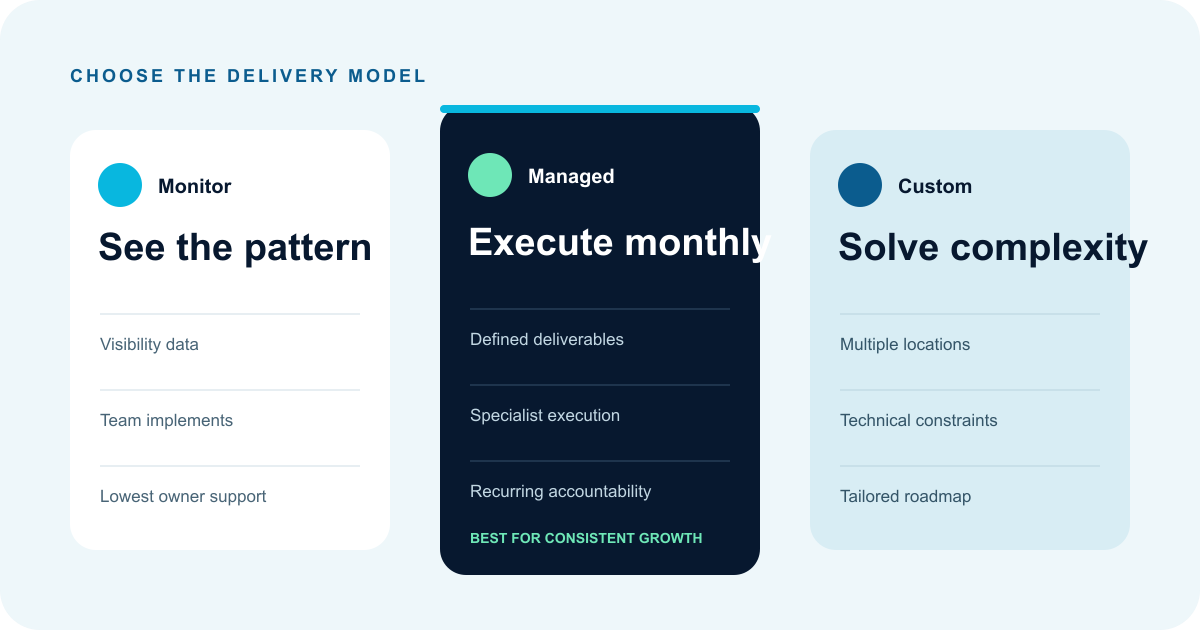
Self-service monitoring is designed for a team that can maintain its own profile, pages, reviews, and listings but needs better visibility data. A defined managed program adds recurring specialist execution. A custom engagement is appropriate when the business has several locations, a difficult market, major website problems, a migration, or broader content and authority needs.
- Self-service monitoring: data and prioritization, with execution owned by your team
- Managed SEO program: recurring technical, content, local, authority, and reporting work
- Custom engagement: a tailored roadmap for complex websites, markets, locations, or growth goals
What a managed program should include
The monthly fee should buy accountable work, not access to a dashboard.
A credible managed program should state what is reviewed, what is changed, how frequently work occurs, what requires client approval, and how results are reported. Not every task happens every month, but the operating system should cover the full path from discovery to conversion.
- Technical search health, crawlability, indexing, canonicals, redirects, and sitemap signals
- Google Business Profile accuracy, categories, services, photos, and customer-facing information
- Service and location content that matches real customer intent
- Listings consistency, legitimate reputation work, and appropriate local authority building
- Measurement across impressions, clicks, calls, forms, bookings, qualified opportunities, and revenue where available
The first 90 days
Expect a sequence, not a monthly pile of disconnected tasks.
The first month should establish access, analytics, Search Console, indexing, technical health, profile accuracy, service priorities, and the conversion baseline. The next phase usually addresses the highest-impact technical and content gaps. Ongoing work then expands relevance, reputation, local proof, and authority while the team monitors lead quality.
That sequence changes with the starting point. A business with a broken migration needs technical recovery before content expansion. A stable site with weak service coverage may move quickly into landing-page and profile work. The roadmap should explain why one priority comes before another.
What changes the price
Complexity comes from responsibility, competition, and the number of moving parts.
The number of locations, services, target markets, website issues, content needs, approval requirements, integrations, and competitors all affect the amount of work. So do access problems, duplicate profiles, inaccurate listings, penalties, migrations, and the need to rebuild conversion tracking.
A lower price may be reasonable for a narrow monitoring need. It becomes risky when the proposal quietly excludes the work required to produce the outcome the buyer expects.
Reporting that matters
Rankings explain visibility. Leads and revenue explain business value.
A useful report connects search visibility to customer behavior. Track impressions, clicks, local actions, calls, forms, bookings, qualified opportunities, and closed revenue where the systems allow it. Segment by service and landing page so growth in a low-value query does not hide a decline in the offer that matters most.
No provider controls Google's rankings, competitors, or customer demand. The provider should control the quality, transparency, and pace of the work it performs.
Warning signs
Be cautious when the promise is specific but the work is vague.
Guaranteed rankings, instant lead promises, hidden deliverables, bulk content without review, undisclosed link tactics, and reports that never connect to customer action are meaningful warning signs. So is a provider that cannot explain who owns the website, profiles, analytics, content, and accounts after the engagement ends.
- A guaranteed map position or ranking deadline
- No named deliverables, cadence, owner, or approval process
- Pages created mainly by swapping city names or repeating the same copy
- No access to analytics, Search Console, reports, or completed work
- No explanation of cancellation, ownership, or what stops when the subscription ends
Choose the right fit
Start with the gap between what the data shows and what your team can execute.
Choose self-service monitoring when the team has the skills and time to make changes. Choose a managed program when the business needs consistent execution and accountability. Choose a custom engagement when the website, locations, market, or operating systems make a fixed package too narrow.
The best proposal is not necessarily the longest. It is the one that makes the work, responsibilities, limitations, timing, and business measures easy to understand before the first invoice.
A practical next step
Managed SEO Growth
Best for a business that wants recurring technical, content, local, authority, and reporting work handled through a defined managed program.
- A stronger search foundation
- Consistent authority building
- Local and AI-search visibility
Common questions
Practical answers before you commit.
How much does Click Media local SEO cost?+
Local Visibility Monitor is $39 per month for self-service measurement. Managed SEO Growth is $599 per month for a defined recurring program. More complex work is scoped separately after the requirements and starting point are understood.
Why do local SEO prices vary so much?+
Providers include different levels of strategy, implementation, content, authority work, reporting, and support. The number of locations, services, technical issues, and competitors also changes the workload.
Should content and website changes be included?+
If those changes are necessary to improve relevance, user experience, or conversion, the proposal should state who will perform them and whether they are included, limited, or separately scoped.
Can local SEO guarantee rankings or leads?+
No responsible provider can guarantee a specific Google ranking or lead volume. The provider can commit to a documented process, transparent work, accurate measurement, and responsive prioritization.
How long should I evaluate a local SEO program?+
Early technical and profile improvements can appear quickly, but competitive local growth often requires several months. Evaluate the quality and completion of the work from the beginning, then judge visibility and lead trends across a meaningful period.