
Local visibility · Measurement guide · 9 minute read
How to measure your business visibility in Google Maps
Showing up in Google Maps is not a single yes-or-no ranking. A business can appear near its address, disappear a few miles away, and rank differently for every service a customer searches.
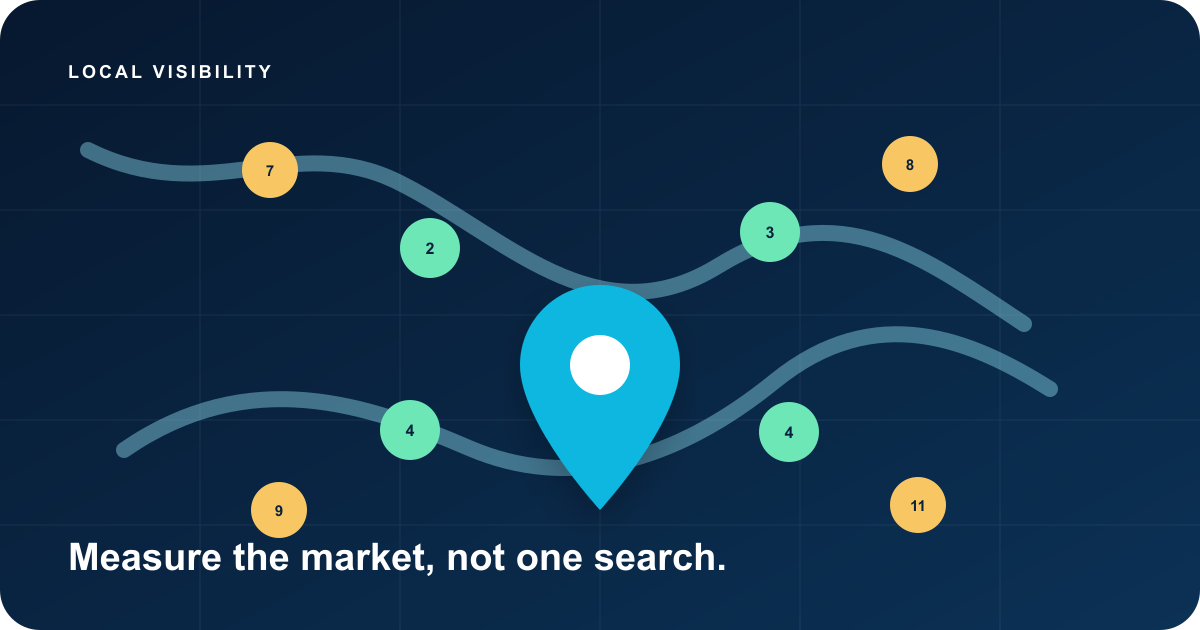
Local search results change with the searcher's location, the query, the device, competition, and the information Google understands about the business. A search performed while signed into your own account may also reflect previous activity. That makes a single manual search useful for a quick spot check, but weak as a measurement system.
Useful measurement separates branded visibility from service visibility and geographic coverage. Can people find the company by name? Can they find it for the services they buy? Does that visibility extend across the places the business genuinely serves? Those are different questions, and each points to a different next action.
01 · Choose the searches
Track customer decisions, not a wall of vanity keywords.
Start with a short list of terms that describe services customers actually buy. Include the primary service, one or two valuable specialties, and an urgent or high-intent need where it applies. Add the business name as a branded reference, but do not let a strong branded result hide weak visibility for the service itself.
A smaller set of commercially meaningful searches is easier to maintain and interpret. Broad phrases can create impressive-looking reports while attracting people who are not likely to become customers.
- A core service that represents dependable revenue
- A specialty service with strong customer value
- A problem or need that often leads to an inquiry
- The business name as a branded control
02 · Measure the real market
Use multiple locations instead of trusting one search.
A local rank grid samples the same search from several geographic points. The pattern shows where the business is visible, where competitors dominate, and how quickly visibility changes with distance. A neighborhood business may need a tight radius. A company serving a city may need wider coverage. A service-area business should measure places it genuinely travels to, not distant cities added only for search reach.
Google explains that local results are mainly shaped by relevance, distance, and prominence. A grid does not control those factors. It makes the geographic pattern easier to see so the team can investigate the right problem.
03 · Save the baseline
Record the starting point before changing the profile or website.
Save the measurement date, tracked searches, grid center, radius, and profile configuration. Also record primary and secondary categories, hours, service areas, linked landing pages, review count, recent review activity, and the customer actions that matter.
Without a baseline, normal variation can look like a crisis and later improvements can be credited to the wrong change. A controlled record makes the work more accountable.
- Business Profile categories, services, hours, and contact details
- Pages connected to the profile and the service each page supports
- Review count, rating, recency, and response process
- Calls, website visits, forms, bookings, and qualified opportunities
04 · Read the pattern
The shape of the map matters more than one average position.
Look for strong visibility near the business but weak coverage in an important nearby area, a competitor that appears consistently across the grid, one service that performs while another disappears, or a drop that begins after a meaningful profile or website change.
Also watch for a more important mismatch: improving visibility without more qualified inquiries. Rankings are a diagnostic signal. The business result still depends on the offer, the profile, the landing page, the response experience, and the ability to convert the right visitor.
05 · Improve deliberately
Connect the visibility problem to the smallest useful change.
A weak pattern can come from incomplete business information, inaccurate categories, thin service pages, inconsistent listings, limited reputation signals, weak local authority, technical website problems, or a poor customer path after the click. Fix the cause that the evidence supports instead of making several major changes at once.
Google does not sell better local rankings, and no responsible provider can guarantee a specific map position. Complete information, useful pages, legitimate reviews, helpful responses, and credible local signals improve the foundation while the market and distance still matter.
06 · Review on a schedule
A consistent cadence turns rankings into a management signal.
Weekly measurement is useful during active improvement work. Monthly monitoring may be enough for a stable business that mainly needs early warning and accountability. Keep the keyword set, grid, and radius consistent enough to compare one period with the next.
Review visibility, engagement, and business outcomes together. That keeps the colored map from becoming the goal and makes it easier to decide whether software is enough or managed SEO is warranted.
- Visibility: map-grid and organic positions by search
- Engagement: calls, website visits, directions, messages, and forms
- Business outcome: qualified inquiries, booked work, sales opportunities, and revenue
Software or managed SEO
Monitoring explains what is happening. Managed work changes the system.
A monitoring subscription can be a strong fit when someone on the team can maintain the profile, website, listings, and review process but needs clearer visibility data. It provides a repeatable baseline and helps prioritize the next investigation.
Managed SEO is a better fit when the business needs someone to diagnose the issue, improve the profile and website, develop content, strengthen authority, and connect reporting to lead generation. The two paths are complementary, not interchangeable.
A practical next step
Local Visibility Monitor
Best for a business that can act on the findings but needs a consistent view of local rankings, profile accuracy, and weekly movement.
- More accurate business information
- A neighborhood-level view
- Clearer search priorities
Common questions
Practical answers before you commit.
How often should I check Google Maps rankings?+
Weekly checks are useful during active improvement work. Monthly monitoring can be enough for a stable business. Consistency matters more than checking every day.
Why does my business rank differently across town?+
Google local results depend partly on the searcher's location. Relevance, competition, and the strength of the Business Profile, website, reviews, and other prominence signals also vary by query.
Does adding more service areas improve rankings?+
Not by itself. Service areas should describe where the business genuinely works. Local visibility still depends on relevance, distance, prominence, competition, and the quality of the business's online presence.
Can a map-grid tool improve rankings automatically?+
No. A grid reveals a pattern. Improvement comes from accurate information, stronger relevance, legitimate reputation and authority, a useful website, and a better customer experience.
Is local rank tracking the same as lead tracking?+
No. Ranking data measures visibility. Lead tracking records calls, forms, bookings, and qualified opportunities. A useful program connects both.