
Local visibility · Audit guide · 11 minute read
How to audit local SEO without getting lost in a hundred metrics
A useful local SEO audit does not produce the longest spreadsheet. It connects what customers can find, what they see, and what they do next to a short list of business priorities.
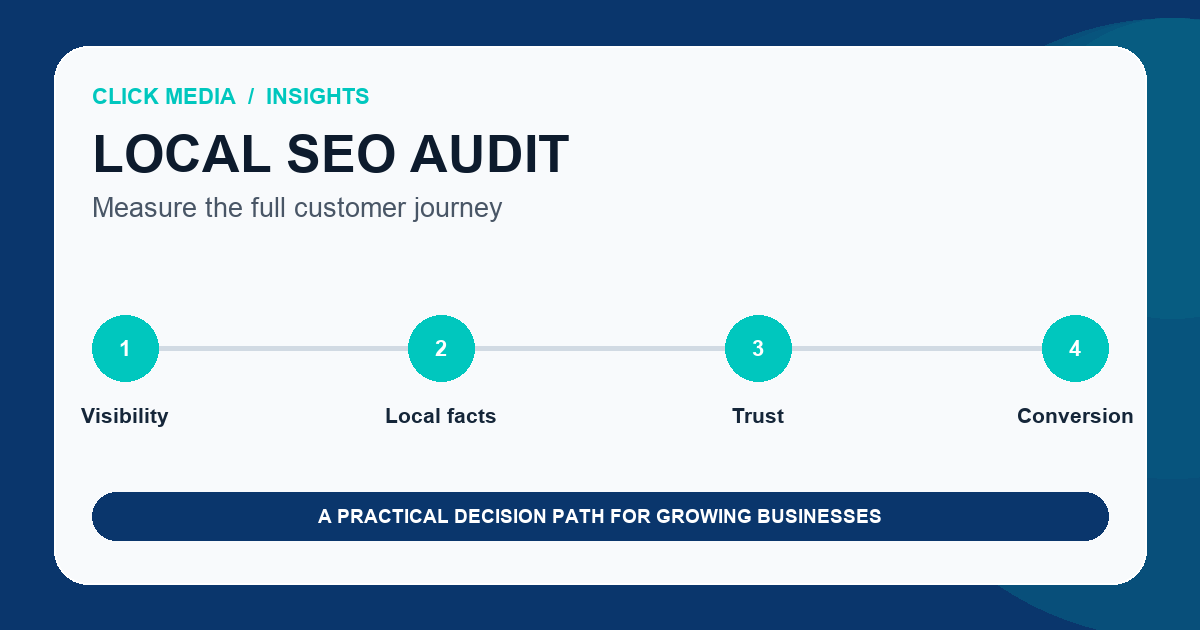
Local visibility is a system. A complete Business Profile cannot compensate for a confusing website, and strong rankings cannot create revenue if calls and forms fail. The audit should follow the customer journey from discovery through decision and response.
Start with evidence already available in Search Console, Business Profile performance, analytics, call records, forms, and customer questions. Tools can surface patterns, but the business context determines which problem deserves attention first.
01 · Establish the baseline
Measure visibility and customer actions before changing anything.
Record branded and non-branded search visibility, the pages receiving organic traffic, map coverage for priority services, Business Profile actions, and qualified inquiries. Use consistent dates and definitions so the next review is comparable.
A baseline keeps normal ranking movement from becoming an emergency. It also prevents the team from crediting a dozen simultaneous changes for one outcome.
- Search impressions, clicks, CTR, and priority positions
- Maps visibility by service and location
- Calls, forms, bookings, and email actions
- Lead quality and closed opportunities where known
02 · Verify the local facts
Make the business easy to recognize across the web.
Review the real-world business name, primary category, additional categories, hours, service areas, phone, website, appointment path, services, and description. The profile should accurately represent how the company operates, not a collection of keywords.
Compare the same core facts across major listings and owned profiles. Prioritize inaccuracies that can confuse customers or search systems instead of chasing every low-value directory.
03 · Review trust and relevance
Inspect the evidence customers use before they contact you.
Review volume alone is not the goal. Look at recency, response ownership, repeated complaints, service-specific feedback, and whether the profile and website answer the questions reviews reveal.
Then review the pages meant to rank. Each priority service needs a useful destination with clear scope, proof, local relevance where genuine, and an action that works on a phone.
04 · Prioritize the work
Fix failures first, then improve the strongest commercial opportunities.
Critical failures include broken forms, incorrect business information, blocked indexing, duplicate profiles, misleading hours, and missing pages for core services. Growth work comes next: clearer service content, better internal links, legitimate reviews, local proof, and authority.
Finish with a 30-day action list, a 90-day growth plan, and a small scorecard tied to qualified demand. The audit is valuable only when it changes decisions.
A practical next step
Managed SEO Growth
Best for businesses that want a specialist team to turn the audit into recurring technical, content, local, and authority work.
- A stronger search foundation
- Consistent authority building
- Local and AI-search visibility
Common questions
Practical answers before you commit.
How often should a local SEO audit be completed?+
Run a focused review quarterly and after major website, location, profile, or tracking changes. Monitor critical items such as form delivery, listing accuracy, and profile notifications more frequently.
Can a free audit replace an SEO strategy?+
No. An audit identifies signals and problems. Strategy decides which customers, services, markets, pages, and improvements deserve investment based on business value and competitive reality.
Should every directory inconsistency be fixed first?+
Prioritize customer-facing and authoritative sources, especially inaccuracies involving the name, phone, location, hours, website, or service area. Low-value listings should not delay more consequential work.