
AI and automation · Onboarding guide · 9 minute read
What an AI receptionist needs before it talks to customers
An AI receptionist should not learn the business by improvising with real customers. Good onboarding creates a controlled knowledge source and a tested operating boundary.
The technology can sound polished before the operating model is ready. That creates a dangerous gap between conversational confidence and factual reliability.
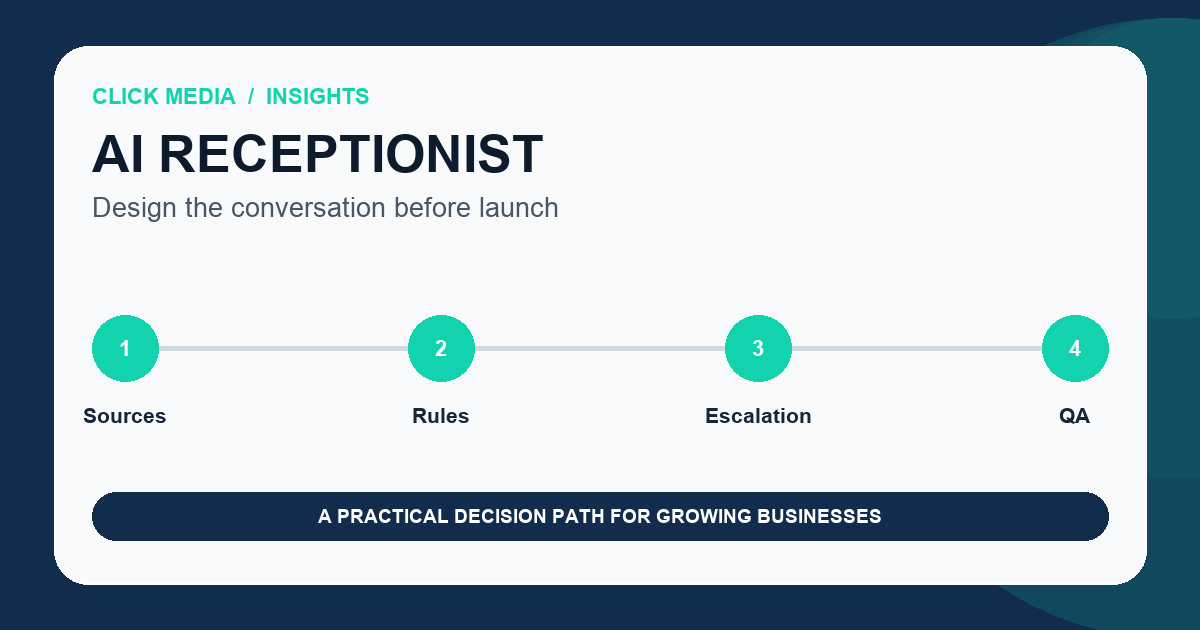
Treat setup like employee onboarding plus software quality assurance. Define what the assistant knows, what it can do, what it must never claim, and how a customer reaches a person.
Knowledge
Build one approved source for customer-facing facts.
Collect the business name, locations, hours, contact options, services, service areas, eligibility, common questions, policies, and approved descriptions. Identify which facts change seasonally or require confirmation.
Avoid importing contradictory webpages and old documents without review. The knowledge source needs ownership and dates.
Conversation design
Define intents, questions, and useful outcomes.
List the most common reasons customers contact the business and decide whether the assistant should answer, qualify, book, route, collect a message, or escalate.
Keep qualification proportional. Asking for unnecessary information creates friction and privacy risk.
Safety and escalation
Write the boundaries before writing the welcome message.
Document emergency instructions, sensitive topics, refund or complaint handling, legal or medical boundaries, authentication, recording disclosure, and opt-out expectations as applicable to the business.
Create an immediate human path for high-value, urgent, angry, vulnerable, or unclear situations.
Testing and ownership
Test normal, difficult, and deliberately confusing conversations.
Use realistic variations, interruptions, typos, accents, background noise, incomplete questions, wrong locations, unavailable appointments, and requests that combine several intents.
After launch, review failures and escalation quality on a schedule. Assign one owner for knowledge changes and one for customer-service exceptions.
A practical next step
AI Receptionist Launch & Care
A structured launch and recurring care package for businesses ready to prepare knowledge, test conversations, and monitor quality.
- Fewer missed opportunities
- Clearer qualification
- Safer handoffs
Common questions
Practical answers before you commit.
How long does AI receptionist setup take?+
Timing depends on knowledge readiness, channels, integrations, booking complexity, testing, and approval. A controlled focused use case can launch faster than a multi-location, regulated, or heavily integrated experience.
Should the assistant disclose that it is AI?+
Use clear, accurate language appropriate to the channel, jurisdiction, and customer expectation. Do not design the experience to mislead people about whether they are interacting with automation.
Who maintains the knowledge after launch?+
Assign a named business owner or approved partner to review hours, services, policies, staff, promotions, and failure patterns. Changes should follow a controlled approval process.